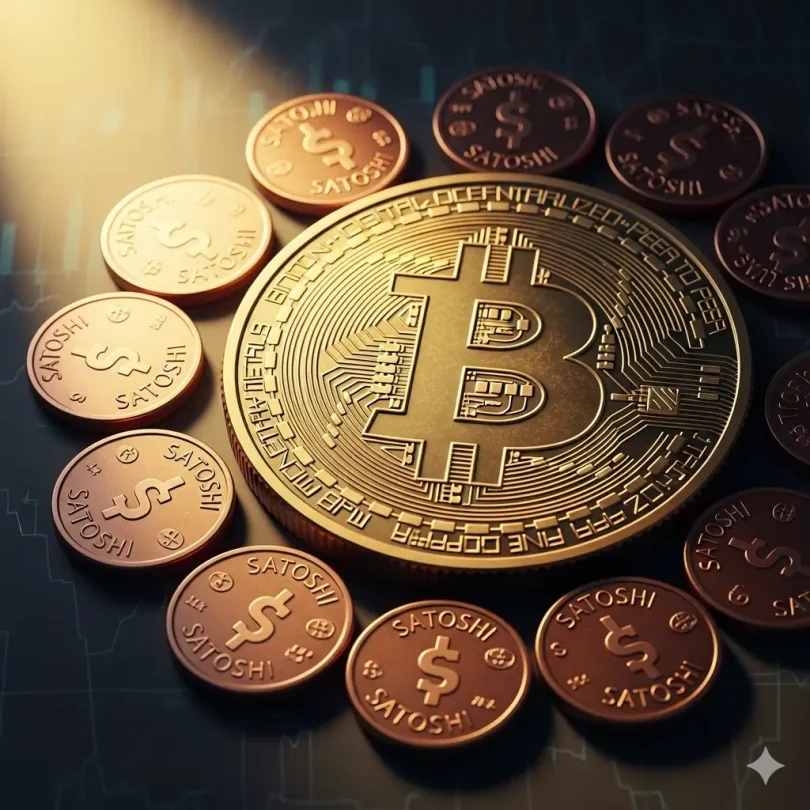

Bitcoin has fundamentally changed the way we think about money, and one of its most innovative aspects is its divisibility. While many people think of Bitcoin as a single unit, often valued at tens of thousands of dollars, it can be broken down into much smaller parts. These tiny units are called “satoshis,” and they are crucial for making Bitcoin accessible and practical for everyday use.
The existence of satoshis enables microtransactions, small investments, and a more inclusive financial system. For anyone new to cryptocurrency, understanding this small but mighty unit is a key step toward grasping the full potential of Bitcoin. This guide will cover everything you need to know about satoshis, from their origin and value to their essential role in the future of digital currency.
What is a Satoshi?
A satoshi is the smallest divisible unit of a Bitcoin. Think of it like cents to a dollar or pennies to a pound. This fractional unit is named in honor of Bitcoin’s mysterious creator, Satoshi Nakamoto. The ability to transact in fractions of a Bitcoin is what makes it a practical currency. Without satoshis, using Bitcoin for small, everyday purchases—like buying a cup of coffee—would be impossible, especially as its value climbs.
By allowing transactions of any size, satoshis help bridge the gap between Bitcoin as a long-term store of value and its function as a medium of exchange. This divisibility ensures that anyone can participate in the Bitcoin economy, regardless of how much they want to invest or spend.
How Many Satoshis Are in a Bitcoin?
There are 100 million satoshis in one Bitcoin (BTC). This high level of divisibility is a core feature of Bitcoin’s design, ensuring it remains usable even if its price reaches astronomical levels.
Here’s a quick breakdown to put that number into perspective:
- 1 Bitcoin (BTC) = 100,000,000 satoshis
- 0.5 BTC = 50,000,000 satoshis
- 0.1 BTC = 10,000,000 satoshis
- 0.01 BTC = 1,000,000 satoshis
- 0.001 BTC = 100,000 satoshis
This structure means you don’t need to buy a whole Bitcoin to own it. You can purchase a tiny fraction, making it an accessible entry point for new investors.
The Origin and History of the Satoshi
The concept of the satoshi was introduced to solve a practical problem: as Bitcoin’s value increased, transacting in whole units became impractical for daily use. The creation of a smaller unit allowed Bitcoin to be more versatile and suitable for a wide range of economic scenarios, from large investments to tiny microtransactions.
The name “satoshi” itself is a tribute to Satoshi Nakamoto, the pseudonymous person or group who published the Bitcoin white paper in 2008 and launched the network in 2009. Nakamoto’s identity remains one of the biggest mysteries in the tech world, but their creation has sparked a global financial revolution. Naming the smallest unit of Bitcoin after its creator is a permanent homage from the cryptocurrency community, recognizing the profound impact of their vision. This legacy extends beyond Bitcoin, influencing the entire field of decentralized finance and blockchain technology.
How Much Is 1 Satoshi Worth?
The U.S. dollar value of a single satoshi is directly tied to the market price of Bitcoin. Because there are 100 million satoshis in one Bitcoin, you can calculate the value of one satoshi by dividing the price of one Bitcoin by 100,000,000.
Let’s look at some examples:
- If 1 BTC = $50,000, then 1 satoshi = $0.0005
- If 1 BTC = $60,000, then 1 satoshi = $0.0006
- If 1 BTC = $70,000, then 1 satoshi = $0.0007
While the value of a single satoshi may seem minuscule, it’s this low barrier to entry that makes Bitcoin so accessible. Newcomers can start their crypto journey by investing just a few dollars, acquiring thousands of satoshis in the process.
Why Satoshis Matter for the Bitcoin Economy
Satoshis are more than just a novelty; they are fundamental to Bitcoin’s function as a global digital cash system. Their existence enables microtransactions, which are small payments that would be impractical or too expensive with traditional financial systems. As renowned Bitcoin educator Andreas Antonopoulos said, “Satoshis are the key to unlocking Bitcoin’s potential for global microtransactions.”
This capability opens up a world of possibilities. Content creators can receive tips in satoshis, online services can charge tiny fees for access, and machine-to-machine payments become feasible. By allowing for these small-value transfers, satoshis help Bitcoin move beyond being just a “store of value” and into the realm of a true medium of exchange.
Practical Uses of Satoshis Today
The theoretical potential of satoshis is already being realized in various real-world applications. Here are a few ways people are using satoshis every day:
- Tipping and Online Content: Platforms like Substack and certain social media plugins allow users to tip creators directly with small amounts of Bitcoin, often facilitated through the Lightning Network.
- Digital Goods and Services: Some online merchants allow customers to pay for articles, music, or other digital items using satoshis, avoiding credit card fees for small purchases.
- Bitcoin-Based Gaming: A growing number of mobile and online games reward players with satoshis for completing tasks or winning challenges, creating a “play-to-earn” model.
- Lightning Network Transactions: The Lightning Network, a Layer 2 solution built on Bitcoin, is designed for fast and cheap transactions. As Lightning Labs CEO Elizabeth Stark notes, “The Lightning Network enables the practical use of satoshis for everyday payments.” It makes sending a few satoshis as easy and inexpensive as sending a text message.
- Dollar-Cost Averaging: Many investors “stack sats” by regularly buying small amounts of Bitcoin. This strategy, also known as dollar-cost averaging, allows them to build their holdings over time without making a large one-time investment.
How to Convert Between Bitcoin and Satoshis
Converting between Bitcoin and satoshis is simple arithmetic.
Bitcoin to Satoshis
To convert an amount of Bitcoin into satoshis, you multiply it by 100,000,000.
Formula: Amount of Bitcoin × 100,000,000 = Number of Satoshis
Example: If you have 0.005 BTC, the calculation is: 0.005 × 100,000,000 = 500,000 satoshis.
Satoshis to Bitcoin
To convert satoshis back into Bitcoin, you divide by 100,000,000.
Formula: Number of Satoshis ÷ 100,000,000 = Amount of Bitcoin
Example: If you have 2,500,000 satoshis, the calculation is: 2,500,000 ÷ 100,000,000 = 0.025 BTC.
Many online calculators and crypto exchange interfaces can do these conversions for you automatically, making it easy to track the value of your holdings.
What Does It Mean to “Stack Sats”?
Stacking sats” is a popular term in the crypto community that refers to the practice of consistently accumulating small amounts of Bitcoin over time. This approach has been championed by influential figures like former Twitter CEO Jack Dorsey. Instead of trying to time the market or make large, risky purchases, stackers make regular, small investments, often daily or weekly.
This philosophy emphasizes Bitcoin’s scarcity—with a fixed supply of 21 million coins—and the long-term potential for its value to appreciate. By focusing on accumulating satoshis, individuals can steadily build a significant position in Bitcoin without needing a large amount of upfront capital. It democratizes investing and encourages a disciplined, long-term perspective.
The Future Role of Satoshis
As Bitcoin continues to evolve, the importance of satoshis is only expected to grow. If Bitcoin’s price rises significantly, transacting in whole bitcoins will become even less practical. At that point, prices for goods and services may be quoted directly in satoshis. As crypto pioneer Wences Casares observed, “Satoshis allow anyone, anywhere to participate in the Bitcoin economy, regardless of their financial status.”
However, there are challenges to overcome for widespread adoption. Transaction fees on Bitcoin’s main layer can sometimes be high, making small satoshi payments uneconomical. This is where technologies like the Lightning Network become critical. By moving small transactions off the main blockchain, the Lightning Network drastically reduces fees and settlement times, making satoshi-level payments viable on a global scale.
Other Units of Bitcoin
While satoshi is the most well-known and smallest unit, other denominations have been proposed and are sometimes used, often mirroring the metric system. These include:
- Millibitcoin (mBTC): Equal to one-thousandth of a Bitcoin (0.001 BTC or 100,000 satoshis).
- Microbitcoin (μBTC): Equal to one-millionth of a Bitcoin (0.000001 BTC or 100 satoshis). This unit is also sometimes called a “bit.”
Though less common in everyday conversation, these units provide additional flexibility for quoting prices and making transactions of different scales.
The Big Picture: A Future Measured in Satoshis
Bitcoin’s divisibility is a testament to its forward-thinking design. By breaking down a single Bitcoin into 100 million satoshis, Satoshi Nakamoto created a system that is both a robust store of value and a practical medium of exchange. This dual identity is what makes Bitcoin so revolutionary.
Satoshis make Bitcoin accessible to everyone, empowering individuals across the globe to participate in a new financial system. Whether you are stacking sats as a long-term investment, earning them through a play-to-earn game, or using them for daily purchases on the Lightning Network, you are part of a growing movement. Each satoshi represents a small piece of a decentralized, secure, and global network that is poised to reshape the future of finance—one tiny unit at a time.
Disclaimer: The contents of this article are not financial or investing advice. The information provided is for educational purposes only and should not be considered as offering trading or investing recommendations. The cryptocurrency market is highly volatile. Any investor should research multiple viewpoints and be familiar with all local regulations before committing to an investment.